Field-based naturalist inventory compiled since 2005 in Khao Yai National Park (UNESCO). Asian elephants, gibbons, great hornbills, reptiles, amphibians. Click on a species to open its field note.
66mammal species recorded
20 yearsof field observations
UNESCOWorld Heritage
Detailed inventory – 66 mammal species recorded in Khao Yai
Wild animals you can see in Khao Yai National Park
Listed as a UNESCO World Heritage Site since 2005, Khao Yai National Park is one of the best preserved natural sanctuaries in Southeast Asia.
It hosts outstanding wildlife: Asian elephants (more than 400 individuals), white-handed gibbons, great hornbills,
gaurs, king cobras, reticulated pythons and 392 bird species recorded in the forest complex.
The cards below come from 20 years of field observations by the Les Collines Khao Yai team,
an independent ecotourism operator based at the park’s edge since 2005.
Khao Yai is part of the Dong Phayayen–Khao Yai forest complex, the largest protected forest block in Thailand.
This continuous habitat is essential to the survival of large mammals: the gaur, the dhole and the Asian elephant all require vast territories that only such a complex can offer.
For birders, the park ranks among the best sites for a birding safari in Thailand,
with up to five hornbill species observable in a single day.
🌿 Observation ethics: all our outings strictly follow Khao Yai National Park regulations.
We practise respectful long-distance watching: no feeding, no deliberate disturbance,
no off-trail walking. We refuse to take part in the wildlife “chasing for photos” sometimes seen in mass tourism circuits in Thailand.
Scientific sources and reference authorities
The conservation statuses shown on this page are based on the IUCN Red List.
Elephant data and local wildlife observations are drawn from Khao Yai National Park authorities and partner naturalists.
Field observations have been compiled since 2005 by the Les Collines Khao Yai team.
IUCN logo displayed for information only to identify the global scientific reference database for conservation status.
Les Collines Khao Yai does not claim any official affiliation with IUCN.
NWA logo used with permission from the founders: Nani Fouad – Secretary General.
Group:
30 species shown
🦣 MammalsFrequent
Asian elephant in Khao Yai
Elephas maximus
▸
📋 Description
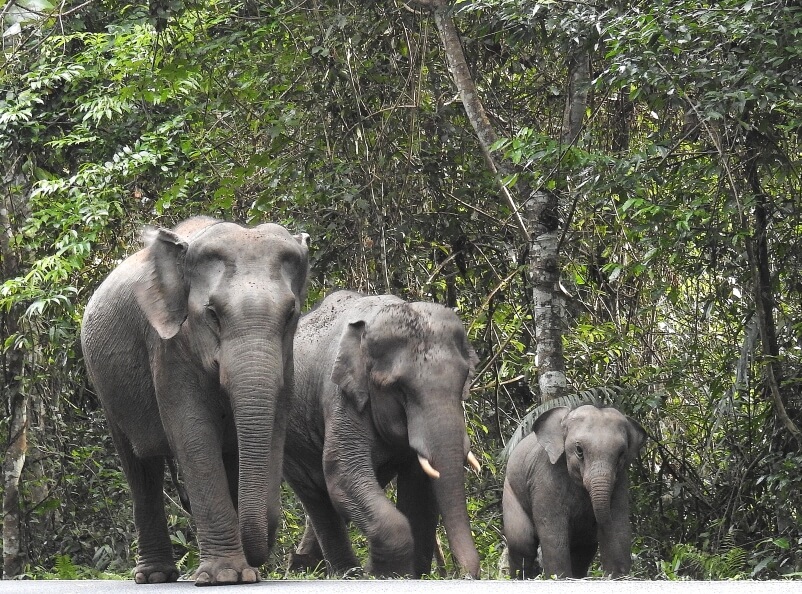
The largest land mammal in Asia. Khao Yai holds more than 400 individuals. Almost daily presence along forest edges and grasslands. Reproduction: about 22-month gestation for a single calf, females giving birth only every 4 to 6 years. Diet: large herbivore feeding on tall grasses, bamboo, young shoots, fallen fruits and bark over long nightly movements.
🔬 Behaviour
Gregarious, lives in matriarchal herds. Mainly active at dawn and dusk. Avoids areas with intense human presence.
👁️ Field observation
Cool season (Nov–Feb): best period. Key areas: Pha Diao Dai and Mo Singto grasslands.
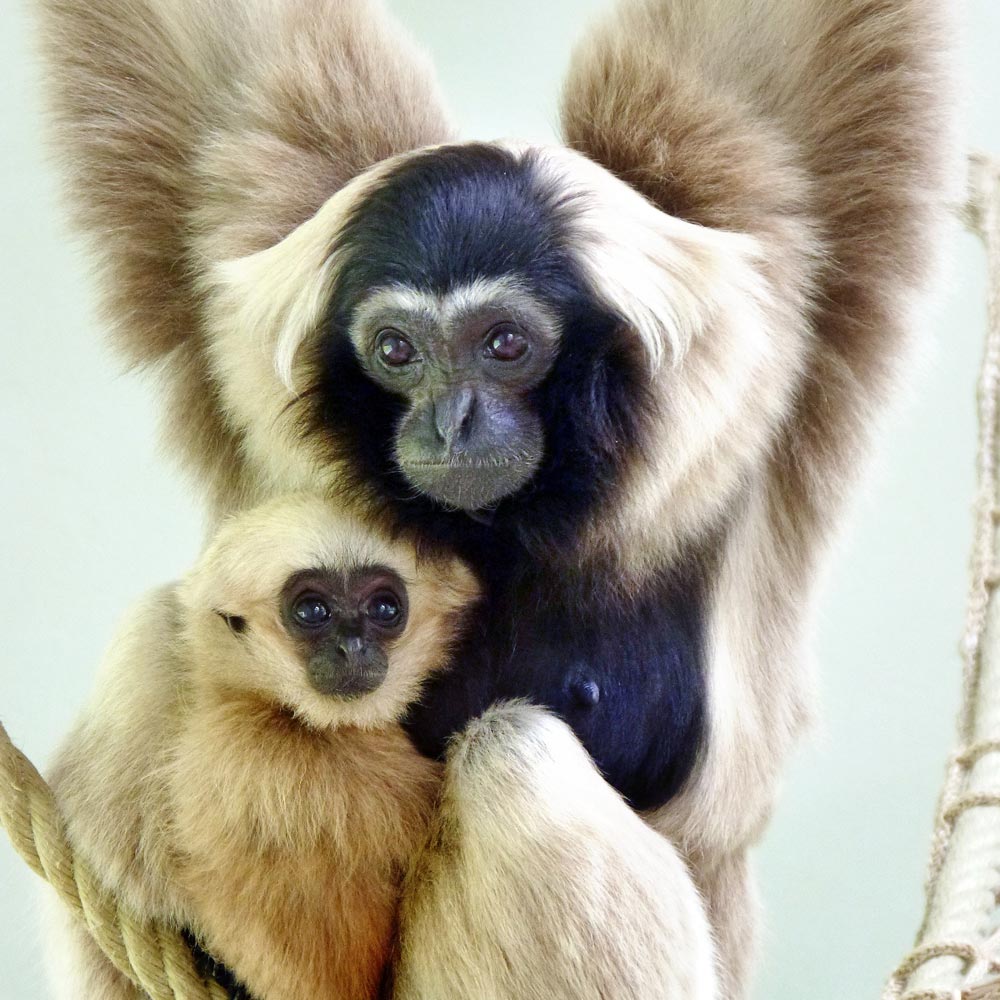
Khao Yai is one of the few places in the world where the white-handed gibbon lives alongside the pileated gibbon, with natural hybrids documented by researchers. Arboreal primate whose dawn song is one of the most memorable soundscapes of Khao Yai. Local population still well represented in primary forest blocks. Reproduction: monogamous pairs, one infant every 2–3 years, with a long learning period alongside the parents. Diet: mainly frugivorous (figs, forest fruits) complemented by young leaves, flowers and occasional insects.
🔬 Behaviour
Lives in family groups. Moves by brachiation in the canopy. Territory defended through morning vocalisations.
👁️ Field observation
Audible from around 5:30 am. Visible at forest edges in the morning. Regular all year round.
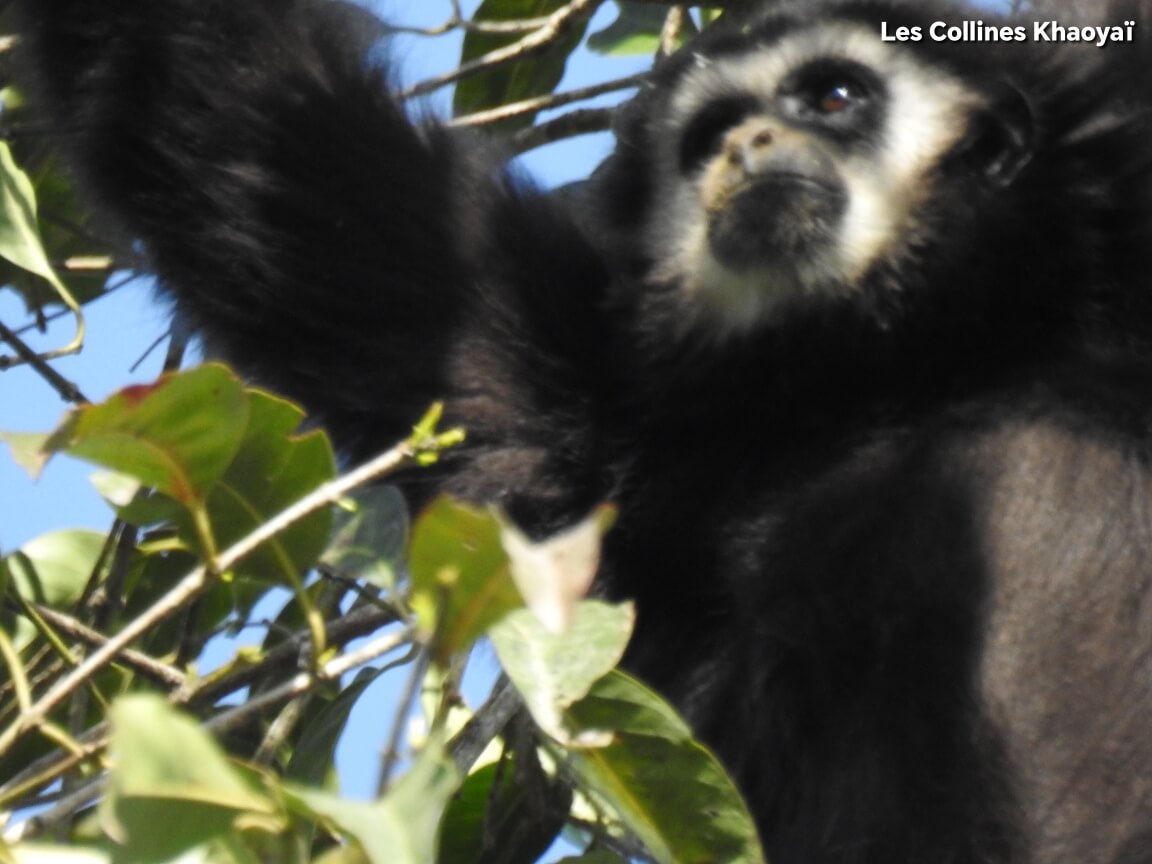
Range limited to south-east Thailand, Cambodia and southern Laos. Striking black-and-white contrast in adult males. Khao Yai lies at the edge of its range: one of the rare contact zones with the white-handed gibbon, where mixed pairs and natural hybrids are observed. Reproduction: small family groups, one infant every 2–3 years. Diet: mainly forest fruits, young leaves, flower buds and occasional insects.
🔬 Behaviour
Performs duet songs with the female. Occupies the high canopy of primary forest.
👁️ Field observation
Especially in the northern and central parts of the park. Best window: 6–9 am.
The largest wild bovine in the world. Impressive silhouette with a characteristic shoulder hump. Reproduction: a single calf per female, staying protected within the herd for long periods. Diet: large herbivore grazing tall grasses, young shoots, shrub leaves and sometimes bark.
🔬 Behaviour
Herds of 8–40 individuals. Grazes in grasslands, retreats to forest during the day. Shy but can be dangerous if cornered.
👁️ Field observation
Grasslands and forest edges at dawn and dusk. Night safaris are effective.
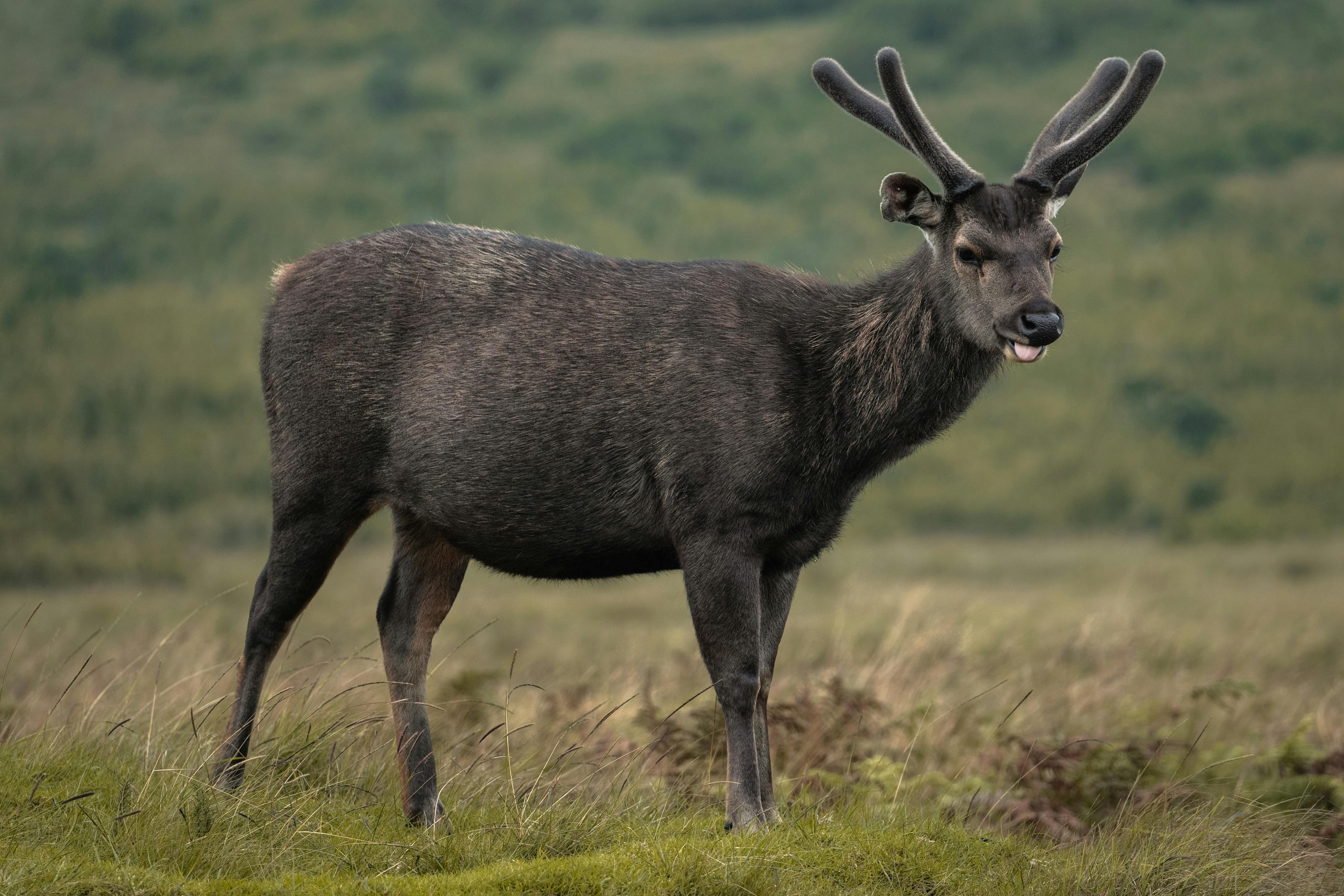
Large deer and main prey of Southeast Asia's large predators. Very common in Khao Yai. Reproduction: one fawn per birth. Diet: opportunistic herbivore feeding on grasses, leaves, buds and aquatic plants.
🔬 Behaviour
Solitary or in small groups. Active at dawn and dusk. Frequently visits waterholes at night.
👁️ Field observation
Grasslands and roadsides. Extremely regular on night safaris.
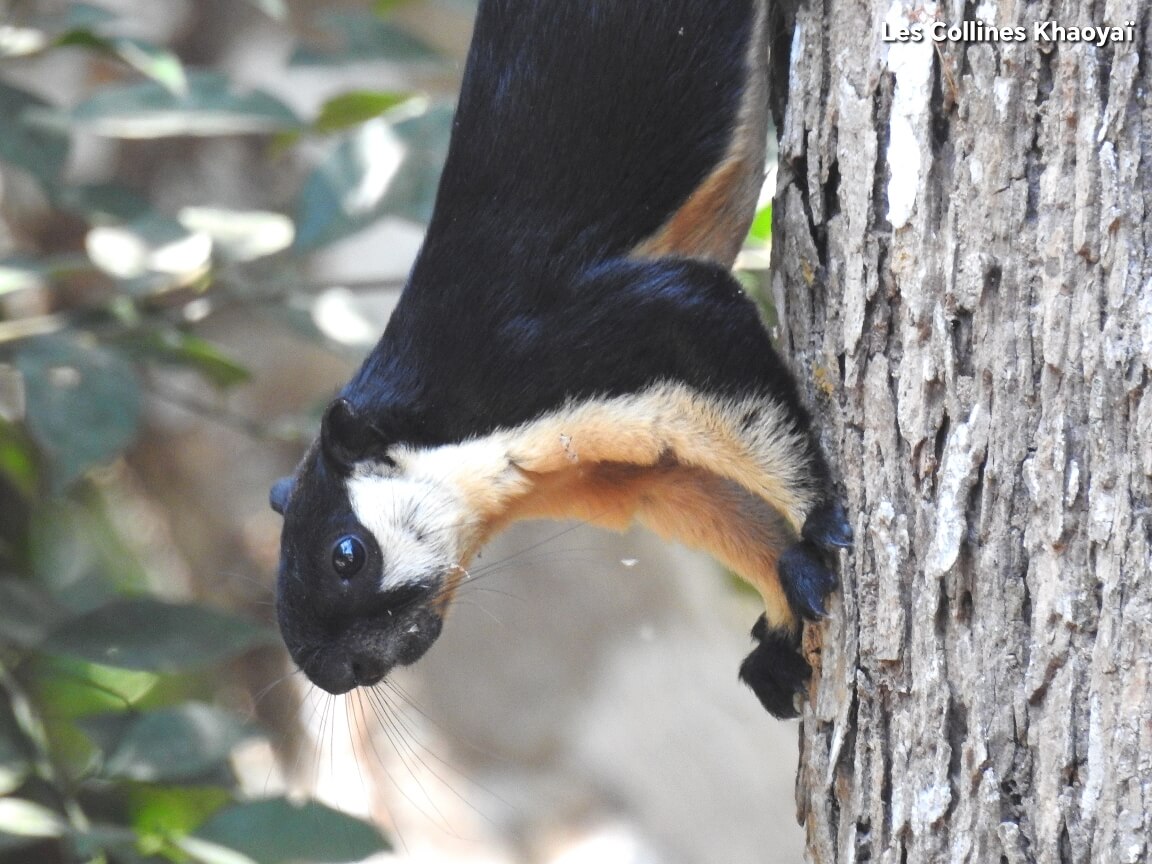
The largest squirrel in Asia. Body length up to 35 cm with striking bicoloured fur. Reproduction: nests high in large trees, one small litter per year. Diet: eats big fruits, nuts, hard seeds, young leaves and sometimes bark.
🔬 Behaviour
Strictly arboreal. Performs spectacular leaps between trees. Often solitary and noisy.
👁️ Field observation
Canopy of dense forest. Usually heard before being seen. Frequent year-round.
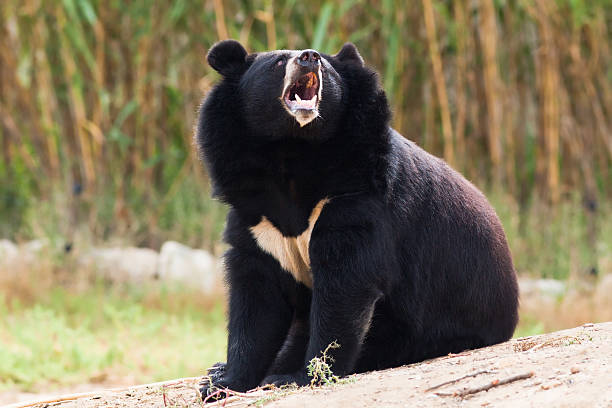
Easily recognised by the pale crescent on its chest. Present in Khao Yai but elusive. Reproduction: one or two cubs per litter; young stay with the mother for a long period. Diet: omnivore feeding on forest fruits, insects, honey, roots and occasionally small vertebrates.
🔬 Behaviour
Mainly nocturnal. Eats large quantities of fruits and insects. Capable climber.
👁️ Field observation
Dense forest zones. Tracks more common than actual sightings.
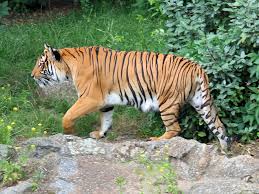
Species absent from recent records. No resident population confirmed in Khao Yai since the late 1990s. Historical presence documented; the Dong Phayayen–Khao Yai complex remains a potential habitat monitored by the DNP. IUCN status: Endangered.
🔬 Behaviour
Solitary with huge territories. Mostly nocturnal. Avoids human contact.
👁️ Field observation
Direct sighting is extremely unlikely. Its presence is a key indicator of ecosystem health.
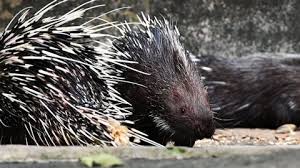
Large rodent covered in quills up to 30 cm long. Common but strictly nocturnal, regularly seen on safaris. Reproduction: one to two litters per year, reared in burrows. Diet: burrowing omnivore that eats roots, tubers, fallen fruits and seeds.
🔬 Behaviour
Strictly nocturnal. Forages on the ground and uses burrows.
👁️ Field observation
Night safaris by vehicle: very frequent along roads and forest edges.
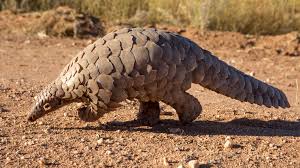
The only mammal entirely covered with keratin scales. Critically endangered due to poaching. Reproduction: a single well-developed young carried on the mother’s back. Diet: specialist feeder on ants and termites.
🔬 Behaviour
Nocturnal and solitary. Rolls into a tight ball when threatened.
👁️ Field observation
Exceptionally observed. A few encounters documented since 2005.
The largest hornbill in Asia. Massive casque on the bill. Flagship bird of Khao Yai. Reproduction: the female is sealed inside a tree cavity and fed by the male. Diet: mainly fruits, supplemented with insects and small vertebrates.
🔬 Behaviour
Pairs or small groups. Nests in cavities of giant trees.
👁️ Field observation
Flight easily recognisable by the loud whooshing of wings. Common in dense forest year-round.
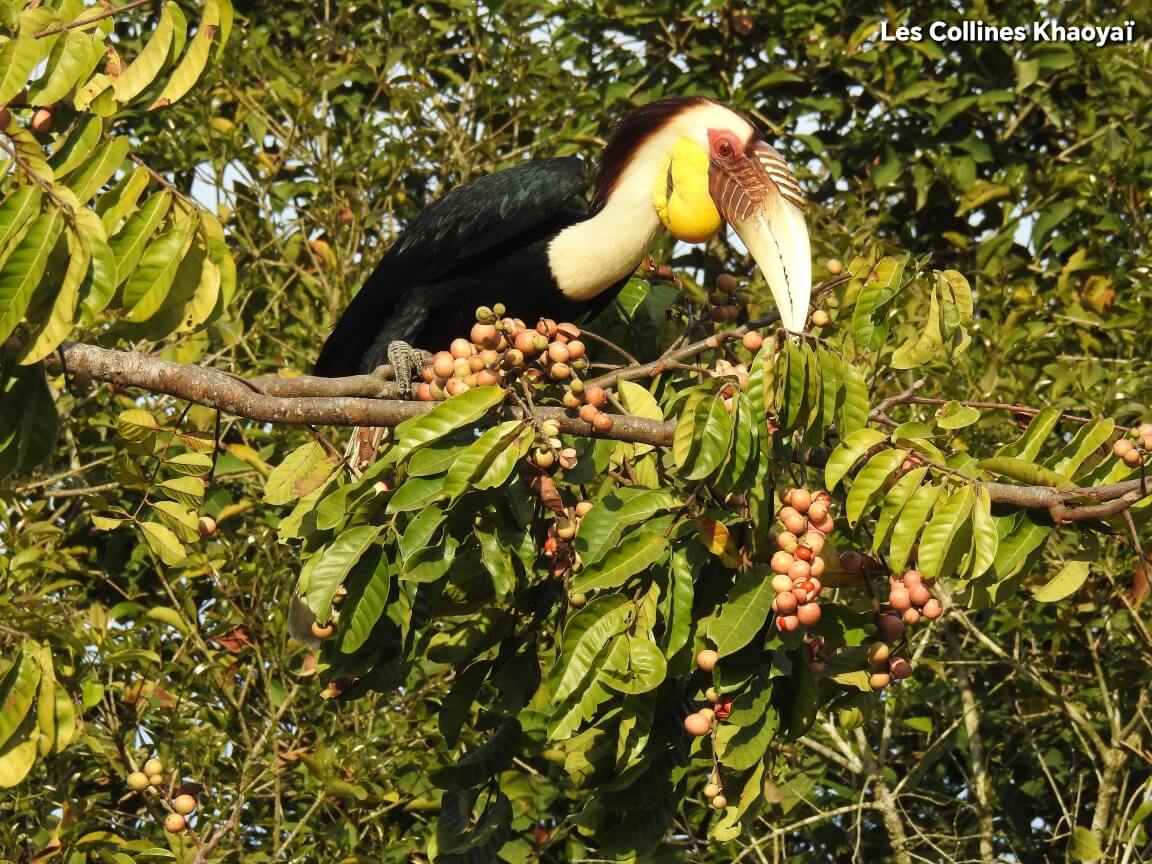
Hornbill with a ridged and colourful casque. Regularly observed in Khao Yai. Reproduction: female sealed into the nest cavity. Diet: mainly frugivorous, dispersing seeds over long distances.
🔬 Behaviour
Gregarious outside breeding season. Frugivore and key seed disperser.
👁️ Field observation
Primary forest canopy. Common all year. Easy to locate by flight and calls.
The most common hornbill in the park. Pale yellow bill with black casque. Reproduction: female sealed inside tree cavity. Diet: fruits, insects and small reptiles.
🔬 Behaviour
Adaptable, often near forest edges. More tolerant of human presence.
👁️ Field observation
Observable almost everywhere in the park. Ideal starter species for beginners.
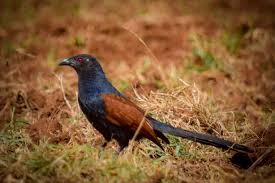
Large ground cuckoo with glossy black plumage and vivid rufous wings. Deep repetitive song is highly characteristic. Reproduction: ball-shaped nest in dense vegetation. Diet: predator of insects, lizards and small snakes.
🔬 Behaviour
Often walks on the ground or in low vegetation along forest edges.
👁️ Field observation
Forest edge and roadside habitats. Song easily heard at dawn.
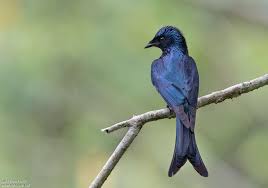
Small passerine with glossy black-bronze plumage. Spectacular aerial acrobat. Reproduction: small cup nest on branches. Diet: insectivore catching prey in flight from perches.
🔬 Behaviour
Sallies out from perches to catch flying insects. Territorial.
👁️ Field observation
Perches along forest edges and inside forest. Easy to observe all year.
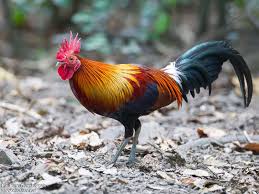
Wild ancestor of all domestic chickens. Its crow announces dawn in the jungle. Reproduction: well-hidden ground nest, eggs incubated by the female. Diet: omnivore pecking seeds, insects and small invertebrates.
🔬 Behaviour
Small family groups. Scratches forest floor for seeds and insects.
👁️ Field observation
Forest edges and grassy clearings. Regular in mornings and late afternoons.
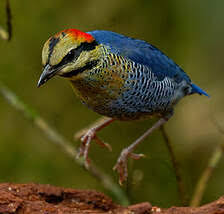
Ground-dwelling bird with dazzling turquoise, black and white plumage. Highly sought-after by birders. Reproduction: low, well-camouflaged nest on the forest floor. Diet: hunts insects, worms and small invertebrates on the ground.
🔬 Behaviour
Secretive, moves quietly across the forest floor in dense undergrowth. Fluted melancholic song.
👁️ Field observation
Understory of primary humid forest. Difficult to see but song is recognisable.
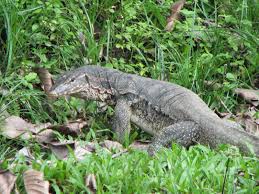
One of the largest lizards in the world, exceeding 2 metres in length. Common near water bodies. Reproduction: lays eggs in burrows or termite mounds. Diet: opportunistic, taking fish, eggs, carrion and small mammals.
🔬 Behaviour
Excellent swimmer. Forked tongue constantly sampling the air.
👁️ Field observation
Riverbanks, lakes and canals. Almost daily observations.
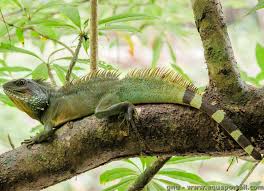
Bright green agamid lizard with a prominent dorsal crest. Strongly dinosaur-like appearance and very photogenic. Reproduction: lays eggs in soft soil. Diet: insectivorous and opportunistic carnivore.
🔬 Behaviour
Semi-arboreal, perches on branches overhanging streams. Dives into water when alarmed.
👁️ Field observation
Streams, waterfalls and forest rivers. Very regular along shaded watercourses.
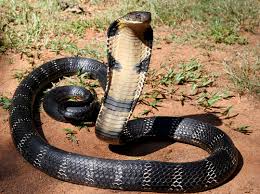
The longest venomous snake in the world (up to 5.5 m). Present in Khao Yai. Reproduction: builds a nest of leaves; the female may guard the eggs. Diet: feeds almost exclusively on other snakes.
🔬 Behaviour
Solitary and mostly diurnal. Avoids human contact.
👁️ Field observation
Dense forest and edges. Never approach or disturb.
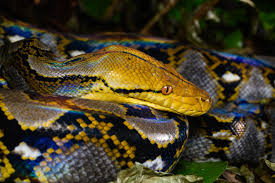
The longest snake species in the world. Some individuals exceed 6 metres. Non-venomous constrictor. Reproduction: female coils around eggs for incubation. Diet: rodents, birds, monitors and civets by ambush.
🔬 Behaviour
Nocturnal and semi-aquatic. Lies in ambush near water.
👁️ Field observation
Water edges at night. Occasionally seen during night safaris.
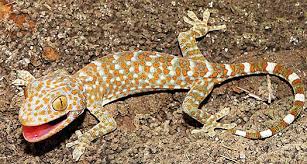
Large gecko with a powerful, resonant call (“to-kay!”). Orange spots on blue-grey background. Very common. Reproduction: lays a few eggs glued to the substrate. Diet: strictly insectivorous, hunting under lights.
🔬 Behaviour
Strictly nocturnal. Its call can be heard tens of metres away.
👁️ Field observation
After dark, under outdoor lights. Almost impossible to miss.
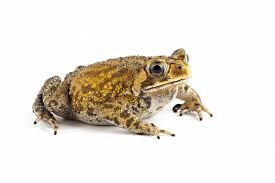
Brown, stocky toad with prominent black parotid glands. Extremely common. Reproduction: long strings of eggs laid in ponds during the rainy season. Diet: nocturnal insect-eater.
🔬 Behaviour
Nocturnal, attracted to light to hunt insects. Toxic if ingested.
👁️ Field observation
Ubiquitous at night around lodges, paths and forest edges.
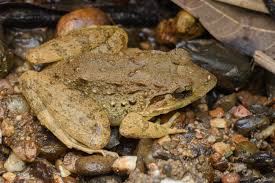
One of the largest frogs in Southeast Asia, weighing up to 500 g. Reproduction: eggs laid in calmer stretches; tadpoles cling to rocks. Diet: insects, small crustaceans and worms.
🔬 Behaviour
Semi-aquatic, stays close to fast-flowing streams. Nocturnal.
👁️ Field observation
Waterfalls and forest torrents. More vocal during the rainy season.
Responsible for the spectacular evening bat flight near Khao Yai. Millions of individuals spiral out of a cave at sunset. Reproduction: one pup per female per year. Diet: specialist insectivore consuming huge numbers of moths.
🔬 Behaviour
Colony of several million individuals. Emerges in a tight spiral at dusk.
👁️ Field observation
Wat Tham Phra bat cave at sunset. Unmissable spectacle.
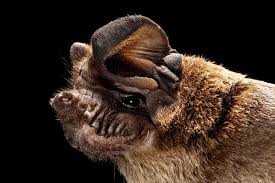
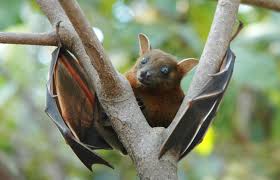
Small frugivorous bat, important seed disperser in tropical forests. Reproduction: one or two litters per year. Diet: fruits such as wild mangoes, figs, bananas and nectar-rich flowers.
🔬 Behaviour
Nocturnal, feeds on fruits and nectar. Roosts in dense vegetation.
👁️ Field observation
Visible at dawn and dusk along forest edges and in gardens.
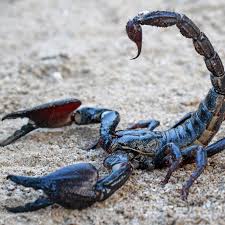
Large black scorpion reaching over 12 cm. Impressive but generally of moderate medical concern. Reproduction: female carries the young on her back after hatching. Diet: carnivorous, eating insects, centipedes and other arthropods.
🔬 Behaviour
Nocturnal, hides under rocks and debris during the day.
👁️ Field observation
Night safaris with UV light: fluoresces bright green in the dark.
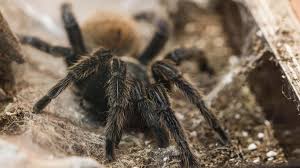
One of the largest tarantulas in Southeast Asia. Ground-dwelling species digging deep burrows. Reproduction: female guards the young in a cocoon at the bottom of the burrow. Diet: insects, centipedes and small lizards.
🔬 Behaviour
Nocturnal and solitary. Rarely leaves its burrow except at night.
👁️ Field observation
Burrow entrances visible along trails. At night, individuals can be seen at the burrow mouth.
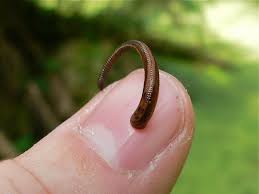
Present in humid forest, especially during the rainy season. Reproduction: hermaphrodites depositing cocoons in saturated soil. Diet: blood of mammals, birds or reptiles.
🔬 Behaviour
Move on vegetation and are attracted by body warmth and vibrations. Bite is painless.
👁️ Field observation
Rainy season (June–October): almost unavoidable. Gaiters are recommended.
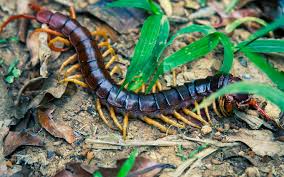
Myriapod reaching up to 30 cm. Active, venomous predator. Bite is very painful. Reproduction: female coils around the eggs until hatching. Diet: insects, other myriapods and spiders.
🔬 Behaviour
Nocturnal, hides under rocks and bark during the day. Extremely fast.
👁️ Field observation
At night under debris on the forest floor. Never handle.
What animals can you see in Khao Yai National Park?
Khao Yai National Park shelters 66 mammal species recorded, of which about ten are realistically observable during a trek: Asian elephants (more than 400 individuals), white-handed gibbons, great hornbills, gaurs, Malayan water monitors, king cobras, reticulated pythons, giant scorpions and 392 bird species recorded in the forest complex. The easiest mammals to see are sambar deer, elephants, monitors and hornbills.
What is the best season to see wildlife in Khao Yai?
The cool season (November to February) is ideal: elephants are frequent in grasslands, gibbons are very active, the vegetation is less dense and visibility is better. The hot season (March–April) is favourable for reptile observations. The rainy season (June–October) is perfect for amphibians and insects.
Can you see tigers in Khao Yai?
No. The Indochinese tiger (Panthera tigris corbetti) is part of Khao Yai's historical fauna, but no resident population has been confirmed here since the late 1990s. Thailand's remaining breeding populations are in the Western Forest Complex (Huai Kha Khaeng, Thung Yai). The Dong Phayayen–Khao Yai complex is the focus of monitoring and prey-recovery programmes. The large predators actually present are the leopard and the dhole, both detected by camera traps and exceptionally rarely seen.
Are there dangerous snakes in Khao Yai?
Yes, Khao Yai hosts several venomous species including the king cobra (the longest venomous snake in the world), various pit vipers and kraits. These snakes are discreet and avoid humans. On treks, simply stay on marked trails and never turn over rocks or dead wood without proper precautions.
How can you see wild elephants in Khao Yai?
Wild elephants in Khao Yai are best seen on night safaris by vehicle or at dawn in the grasslands around Pha Diao Dai and Mo Singto. The cool season (November–February) is the best time. Our team at Les Collines Khao Yai leads specialised treks to maximise respectful elephant encounters.
See these species in the wild
Our naturalist guides take you to the best areas of the park to meet Khao Yai’s wildlife in its natural habitat.



 Frequent